She had been looking for fourteen months when she called me.
Not because she couldn’t find houses. There were plenty of houses. She’d seen forty-three of them. She had a spreadsheet. She had a saved search on every platform, alerts set to notify her the moment something new hit the market. She’d driven past neighbourhoods at night to see what the streets felt like after dark. She knew the inventory better than most agents.
The issue wasn’t the search. The issue was that every time she got close, something was wrong. Too expensive. Too far. Too much work. And so she’d pass, and tell herself the same thing she’d been telling herself for over a year.
“The right one is out there. I just haven’t found it yet.”
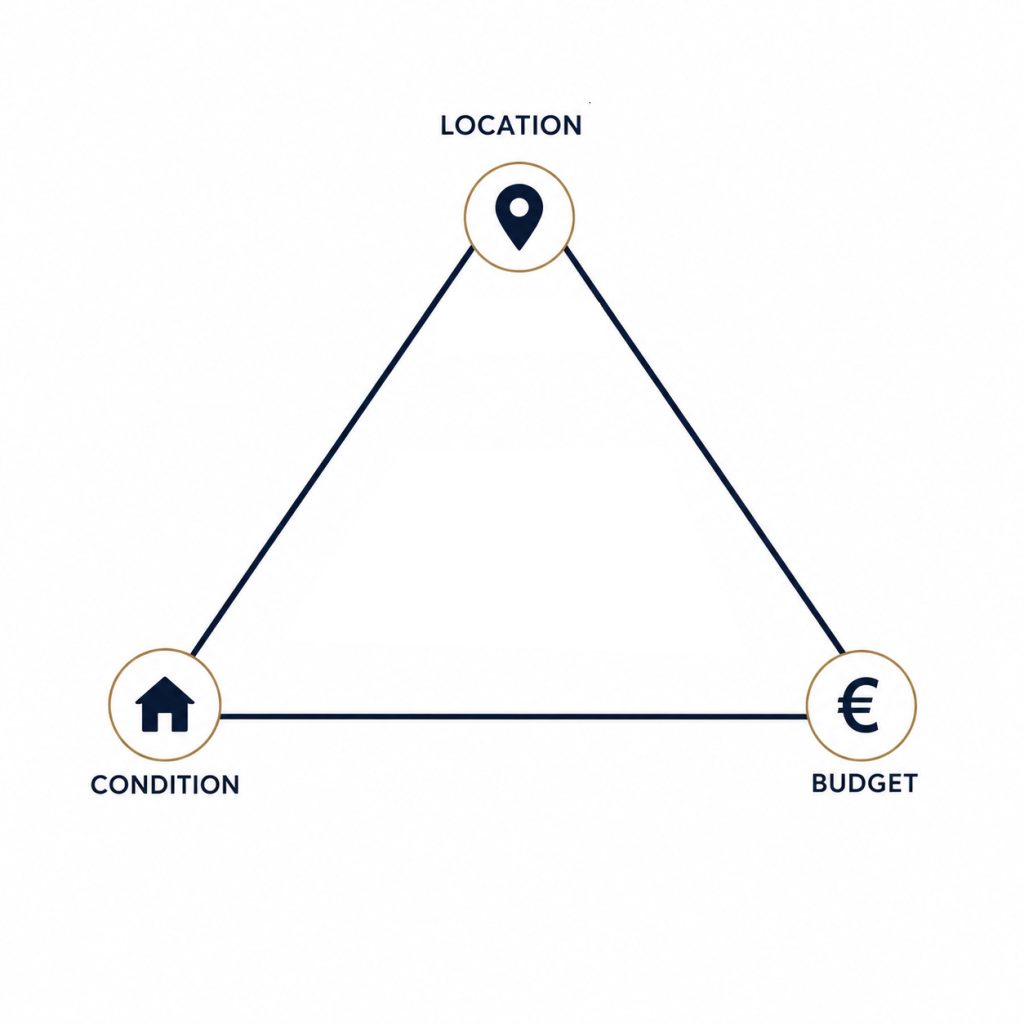
I didn’t tell her she was wrong. I asked her to sit down, and I drew her a triangle.
Here is what I have learned after years of helping people find homes. Not about interest rates or negotiation tactics or which neighbourhoods are up and coming. Something simpler than all of that, and more important.
Every home that exists — every listing, every private sale, every property you’ve ever seen or saved or dismissed — sits inside a triangle. Three corners. Location, Condition, and Budget. And the market, which is nothing more than thousands of people wanting the same things you want, will give you two of them. It has always only given you two. The moment a home appears that offers all three — the right street, the right condition, the right price — it is gone before most people see it. Bought that morning. Sold before it was listed. What remains for you, every time you open the app at 11pm, is the trade-off.
I watched a man choose the first corner once. Location and Condition. The neighbourhood he wanted, the house that needed nothing. He went above his budget. He knew he was overpaying. He bought it anyway. Eventually he told me it was the best financial decision he’d ever made, not because the numbers worked out, but because he’d never once resented the house. He came home to it every evening without a project waiting for him, without a wall that needed opening, without a compromise that had quietly grown into a grievance. He paid for certainty. Certainty, it turned out, was worth every cent. That worked for him.
I watched a woman choose the second corner. Location and Budget. The right area, the impossible price. She got in. She celebrated. Then the weekends started. The contractors who quoted one number and invoiced another. The wall she opened that was hiding something neither of them had priced in. The renovation that was supposed to take four months and took fourteen. She doesn’t regret it — she has equity now that the other path wouldn’t have given her, and a house that is entirely hers in a way that only comes from building it together. The discount was real. So was the bill. It just arrived in a different currency. That worked for her.
And I watched a couple choose the third corner. Condition and Budget. The beautiful home, well-maintained, nothing to fix, priced right. Fifteen minutes further out than they wanted. They had moved the cost somewhere they couldn’t see it at the time. But it was always there, waiting. That worked for them too.
The third corner is never free. That is one thing I know to be true in every market, in every season, regardless of rates or inventory or how long you have been searching. The cost doesn’t disappear when you stop looking at it. It changes form. It becomes time, or sweat, or distance, or the quiet accumulation of a commute multiplied by five hundred mornings. You will pay it. The only question is which currency you are most willing to spend.
The woman with the spreadsheet sat across from me and looked at the triangle for a long time.
She had been hunting all three corners for fourteen months. Not because she was unreasonable, but because nobody had ever told her that all three don’t exist in the same place at the same time. She had been measuring every house against a standard the market was never going to meet. And while she measured, prices moved, and the homes she could have loved were bought by people who had made their peace with the trade-off.
She asked me which two corners she should pick. I told her that was the one thing I couldn’t answer for her. What I could tell her was that the buyers who find their home — and feel good about it years later, not just on the day they sign — are the ones who make that choice on purpose. Who look at the corner they are giving up, name it clearly, and decide they can live with paying for it in the way it asks to be paid.
She bought a house three months later. Not perfect. Two corners. Exactly right.
Before you look at another listing, decide which corner you are willing to give up. Name it. Say it out loud. Then go find your two.
If you know someone who has been searching for a long time and nothing seems to fit, send them this. The triangle might save them another year of looking.